

 Français
 Español
 Products

 About Us




Quick Answer
The phrase “phlegm trap” is sometimes used informally to describe how mucus captures dust, microorganisms, and other inhaled particles in the respiratory tract. It is not a separate organ. In clinical care, a medical mucus trap is a collection device connected to a suction system to capture respiratory secretions or specimens. These two concepts are related through the process of airway secretion clearance, but they are not the same thing.
Mucus is part of the respiratory tract’s natural defense system. Together with microscopic cilia and coughing, it helps prevent inhaled particles from reaching deeper areas of the lungs. When a patient cannot clear secretions effectively or when a respiratory specimen is required, clinical suction and a mucus trap may be used to collect the aspirated material. This guide explains the connection between natural mucus clearance and the medical mucus trap used in suction and specimen-collection systems.
What Is the Body’s Natural “Phlegm Trap” and How Does It Work?
The respiratory tract does not contain a separate structure officially called a “phlegm trap.” The expression is sometimes used to describe the combined action of mucus and cilia in capturing and removing inhaled material. This process is more accurately known as mucociliary clearance.
Mucus captures particles: The moist mucus layer can retain dust, pollen, microorganisms, and other particles entering the airway.
Cilia move the mucus: Microscopic hair-like cilia beat in a coordinated direction and move mucus toward the throat.
Coughing supports clearance: When secretions or irritants accumulate, coughing can help expel material from the airway.
Normal clearance protects the lower airway: Together, these mechanisms reduce the amount of inhaled material that reaches deeper lung tissue.
This natural defense system explains why many educational searches refer to mucus as a “trap.” However, a medical mucus trap is a separate physical device used during suction or specimen collection.
When Natural Mucus Clearance May Need Clinical Support
Normal mucociliary movement and coughing are often sufficient to clear respiratory secretions. In some clinical situations, however, a patient may not be able to remove secretions effectively, or a healthcare professional may need to collect an aspirated specimen for observation or laboratory analysis.
Clinical suction may be used according to professional assessment and institutional protocol when:
The patient has difficulty clearing respiratory secretions through coughing.
Secretions need to be removed during airway management or respiratory care.
A sputum, tracheal aspirate, or other respiratory secretion specimen is required.
The collected material needs to remain visible, measurable, or contained before further handling.
This is where suction catheters, suction tubing, a suction source, and a mucus collection device may form part of the same clinical system.
What Is a Medical Mucus Trap?
A medical mucus trap is a collection chamber used within a suction pathway to capture respiratory secretions or specimens. Depending on the product configuration, it may be referred to as a mucus trap, mucus specimen trap, suction specimen trap, sputum trap, or mucus extractor.
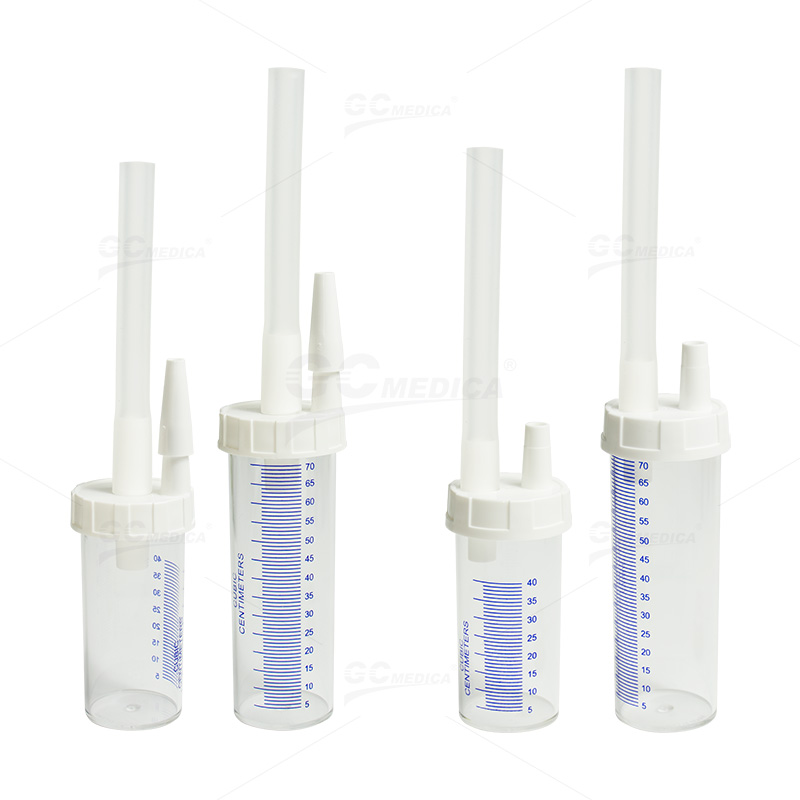
The device generally includes a transparent collection chamber and patient-side and suction-side connections. As suction is applied, secretions pass through the patient-side tubing or catheter and enter the chamber. The collected material remains in the container rather than continuing directly into the wider suction system.
| Device Feature | Purpose in the Collection System |
|---|---|
| Transparent chamber | Allows the collected secretion or specimen to remain visible. |
| Graduated markings | Support visual estimation of the collected volume when included in the product design. |
| Patient-side connection | Connects to the suction catheter, patient tubing, bronchoscopy connection, or integrated catheter, depending on the model. |
| Suction-side connection | Connects the collection chamber to suction tubing or the suction source. |
| Transport or sealing cap | Supports closure of the container after collection when provided with the selected configuration. |
The exact chamber capacity, tubing arrangement, connector design, catheter inclusion, sterility, and closure method vary by model and should be confirmed from the product specification.
How Does a Mucus Trap Connect to a Suction System?
A mucus trap is commonly positioned between the patient-side suction component and the suction source. The general flow path can be understood as:
Patient or Suction Catheter
↓
Mucus Trap Collection Chamber
↓
Suction Tubing
↓
Suction Source
During operation, the suction source creates negative pressure through the system. Respiratory secretions are drawn through the catheter or patient-side tubing and collected in the mucus trap chamber. The healthcare professional should follow the applicable instructions for use and confirm that each connector is correctly matched before suction begins.
Important: Connector orientation, suction pressure, catheter selection, aseptic handling, specimen closure, and disposal or transport procedures must follow the selected device instructions and the healthcare facility’s approved protocol.
Common Types of Mucus Traps and Collection Devices
The term “mucus trap” covers several configurations. The most suitable option depends on whether the main objective is secretion removal, specimen collection, bronchoscopy use, integrated catheter access, or a specific suction-control arrangement.
GCMEDICA Mucus Trap and Mucus Collection Product Range | |
| Typically combines a collection chamber with a catheter or tubing arrangement for secretion suction and collection. Available configurations may vary by catheter size, chamber design, connector, and optional barrier feature. |
| Mucus Trap with Integral Catheter Integrates the collection chamber with a patient-side catheter or tubing configuration. Selected GCMEDICA models include clear vials, graduations, tubing, and a spare screw cap. |
| Designed primarily to collect respiratory mucus or aspirated material in a clear chamber. GCMEDICA lists 40 ml and 70 ml configurations with different cap, adaptor, and labeling arrangements. |
| A sterile, single-use collection option with an integrated connector and tube arrangement. The exact available capacity, anti-overflow structure, packaging, and market documentation should be confirmed for the selected model. |
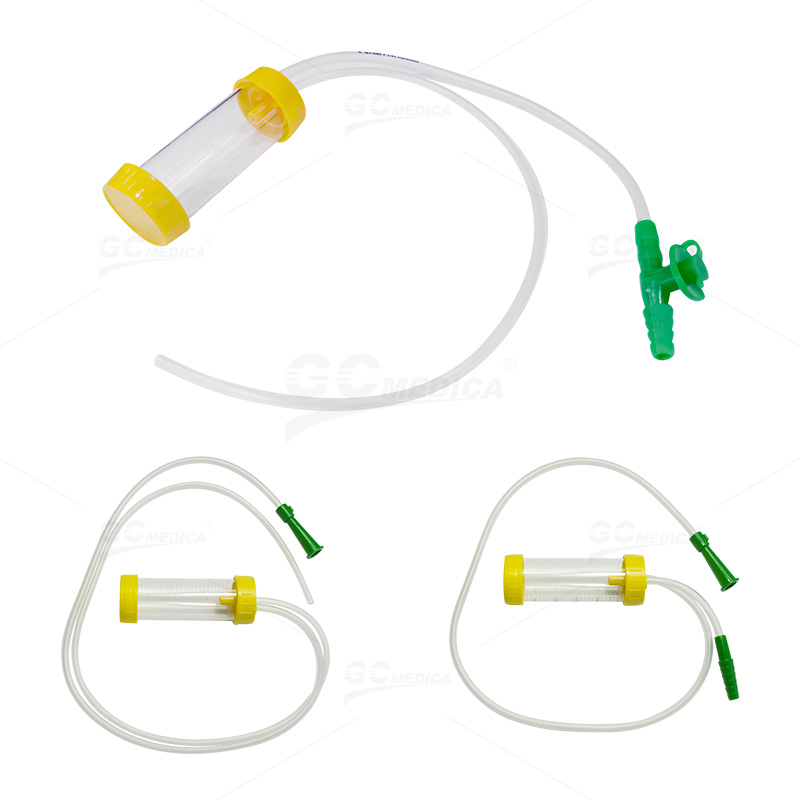
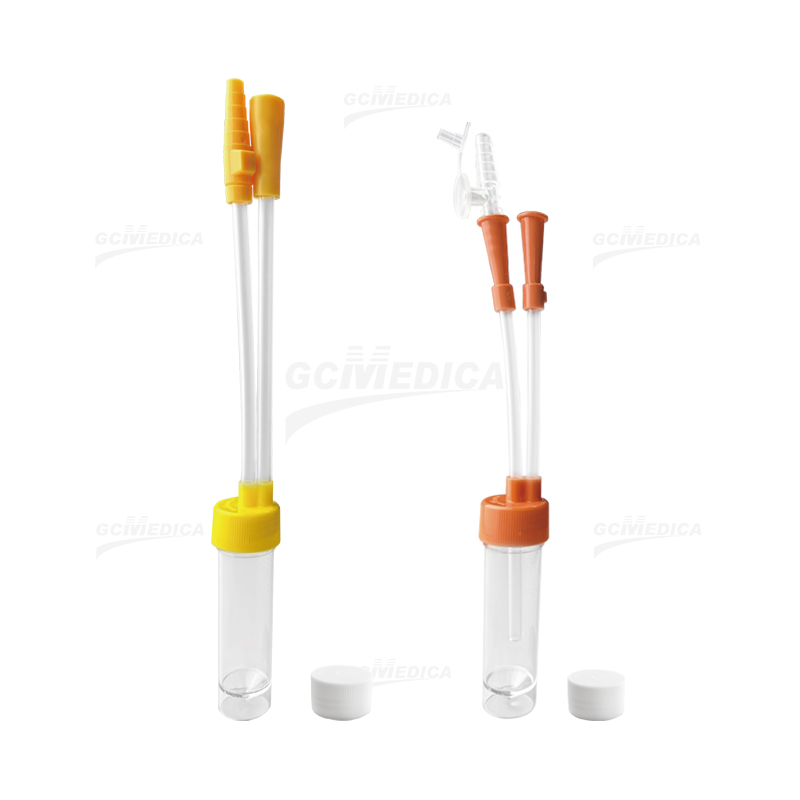
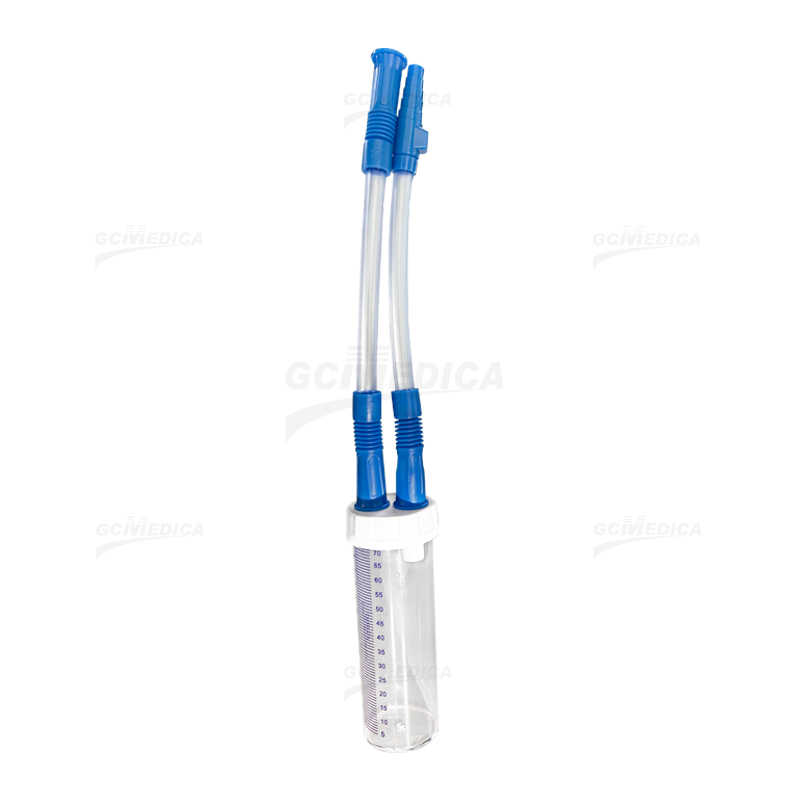
Other configurations may include a vacuum breaker, bronchoscopy-specific tubing, reduced-length connections, alternative chamber capacities, spare caps, patient labels, or different connector arrangements.
Mucus Trap vs. Mucus Extractor: What Is the Difference?
The terms mucus trap, mucus specimen trap, and mucus extractor are sometimes used differently across suppliers and markets. The product name alone may not fully describe the device configuration.
| Term | Typical Product Emphasis | Details to Confirm |
|---|---|---|
| Mucus trap | General collection chamber used in a suction pathway. | Capacity, connectors, tubing, sterility, and intended collection purpose. |
| Mucus specimen trap | Collection and containment of an aspirated respiratory specimen. | Closure method, graduations, label, adaptor, and transport handling. |
| Mucus extractor | A more integrated secretion-removal arrangement, often including a catheter or patient-side tubing. | Catheter size, tip design, chamber capacity, connector, tubing, and optional barrier feature. |
For procurement and compatibility review, it is more reliable to compare the actual structure and specification than to rely only on the product name.
What Should Buyers Confirm Before Selecting a Mucus Trap?
A mucus trap should be selected as part of the complete suction or specimen-collection pathway. Buyers, distributors, and healthcare facilities may need to confirm the following points:
Intended purpose: Secretion removal, specimen collection, bronchoscopy use, or another approved application.
Collection capacity: Chamber volume and graduated scale requirements.
Patient-side configuration: Integral catheter, separate catheter, short tubing, long tubing, or bronchoscopy connection.
Suction-side compatibility: Connector dimensions and compatibility with the facility’s suction tubing or source.
Closure and handling: Spare cap, removable adaptor, sealing method, label, and specimen-transport requirements.
Sterility and packaging: Sterile status, single-use labeling, individual packaging, and shelf-life information.
Market documentation: Product specifications, quality documentation, labeling, and regulatory information required for the intended market.
When multiple configurations are available, the selected mucus trap, catheter, tubing, and suction source should be reviewed as a connected system rather than as isolated products.
Frequently Asked Questions
Is the “phlegm trap” a real organ?
No. The expression is sometimes used informally to describe how mucus captures inhaled particles. The actual airway defense process involves mucus, cilia, coughing, and mucociliary clearance.
How does mucus trap pathogens and particles?
The mucus layer retains inhaled material, while cilia move the mucus toward the throat. Coughing can provide additional clearance when secretions or irritants accumulate.
What is a medical mucus trap used for?
A medical mucus trap is used within a suction pathway to collect respiratory secretions or specimens in a dedicated chamber.
Where is a mucus trap connected?
It is generally positioned between the patient-side catheter or tubing and the suction tubing or suction source. The exact orientation must follow the selected device instructions.
Is a mucus trap the same as a mucus extractor?
The terms can overlap, but the structures may differ. A mucus extractor often includes a more integrated catheter or tubing arrangement, while a specimen trap may focus primarily on collection and containment.
Can one mucus trap fit every suction system?
Not necessarily. Connector design, tubing dimensions, chamber configuration, and the intended application should be checked before ordering or use.
Conclusion
The respiratory tract’s natural “phlegm trap” is not a separate organ but the combined action of mucus, cilia, and coughing. When natural secretion clearance is insufficient or a respiratory specimen must be collected, a medical mucus trap can form part of the suction pathway. Understanding both concepts helps readers move from basic airway education to a clearer understanding of how mucus traps, specimen traps, and mucus extractors are used in clinical collection systems.
Product and Compatibility Support
GCMEDICA provides mucus extractors, mucus traps with integral catheters, mucus specimen traps, sterile specimen-collection configurations, and related suction catheters. Available capacity, catheter size, connector arrangement, tubing, sterility, packaging, labeling, and regulatory documentation should be confirmed according to the selected product and intended market.
Related Products
• Mucus Trap with Integral Catheter
• Mucus Trap with Vacuum Breaker